Choosing the right steel for CNC machining starts with understanding the component’s working conditions, dimensional requirements, and manufacturing constraints. Rather than selecting a grade based only on strength or price, engineers should evaluate how the material will perform throughout machining, heat treatment, and actual service. A systematic steel grade selection process helps reduce manufacturing risks, avoid unnecessary processing costs, and achieve consistent part quality.
Steel selection should begin with the engineering requirements of the finished component, not a general preference for a particular material.
Several factors influence whether a steel grade is suitable for a specific CNC machining project.
Consider the forces acting on the component during operation.
A shaft exposed to repeated torsional loads requires a different material strategy from a lightly loaded mounting bracket. Components subject to impact, vibration, or cyclic loading also need adequate toughness and fatigue resistance.
Engineers should identify:
The material should satisfy the actual mechanical requirements without introducing unnecessary manufacturing difficulty.
Material selection also affects the ability to maintain dimensional accuracy.
Parts with eccentric features, thin walls, deep holes, or closely spaced machining surfaces can be sensitive to cutting forces and residual stress.
For these components, consider:
A material that performs well in a simple shaft may require additional process controls when used in a complex precision component.
The final manufacturing process should be considered before confirming a steel grade.
Determine whether the component requires:
These operations can influence material selection, machining sequence, and production cost.
When engineers compare steel grades, the objective should be to identify meaningful differences in manufacturing behavior and engineering suitability rather than simply comparing material names.
The following table provides a decision-oriented reference for commonly considered grades.
| Steel Grade | Main Selection Consideration | When to Consider It |
|---|---|---|
| 1018 | General machining efficiency | Components with moderate mechanical requirements |
| 1045 | Strength and heat-treatment potential | Shafts and mechanical parts requiring greater strength |
| 1215 | High-volume machining efficiency | Repetitive precision-turned components where its limitations are acceptable |
| 4140 | Strength and toughness balance | Components exposed to substantial mechanical loads |
| 40CrNiMoA | High-load mechanical performance | Demanding mechanical components requiring controlled heat treatment |
| Cr12 | Wear resistance after suitable hardening | Cold-work tooling and wear-resistant components |
| H13 | Performance under elevated temperatures | Hot-work tooling exposed to thermal cycling |
| S136 | Corrosion resistance and polishing requirements | Precision mold components requiring suitable surface quality |
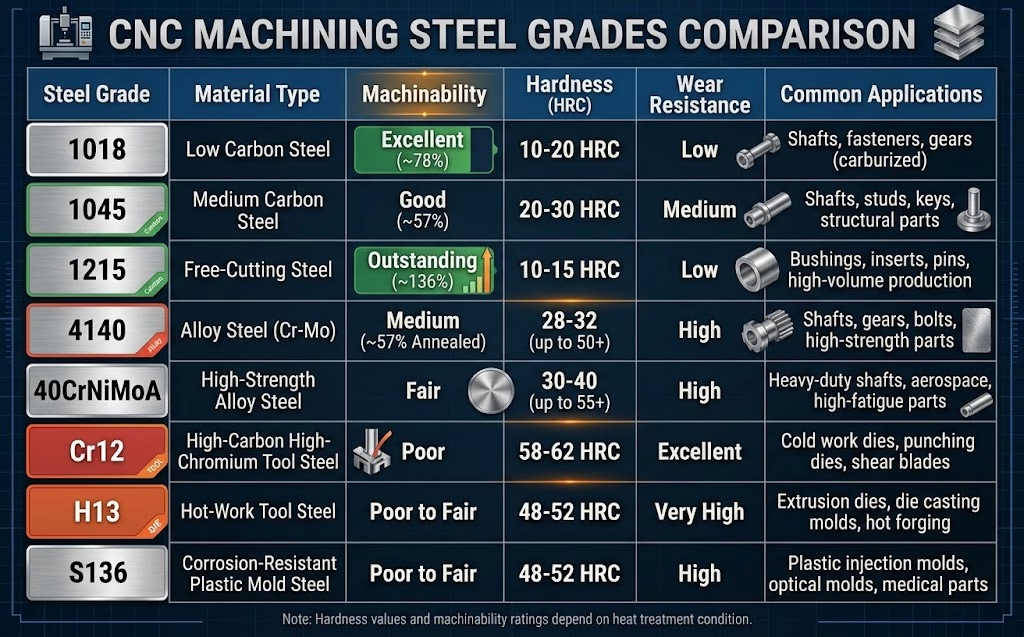
These grades are not interchangeable. Their actual performance depends on material specifications, product condition, heat treatment, and manufacturing requirements.
A meaningful comparison should use the same evaluation criteria for every candidate.
For example:
The most suitable grade is the one that satisfies the component’s requirements with the lowest practical manufacturing risk.
Hardness is an important factor in CNC machining, but it should not be treated as the only indicator of machining difficulty.
In general, increasing material hardness can increase cutting forces, accelerate tool wear, and make dimensional control more demanding. However, machinability also depends on material composition, microstructure, heat-treatment condition, cutting tool geometry, and machining parameters.
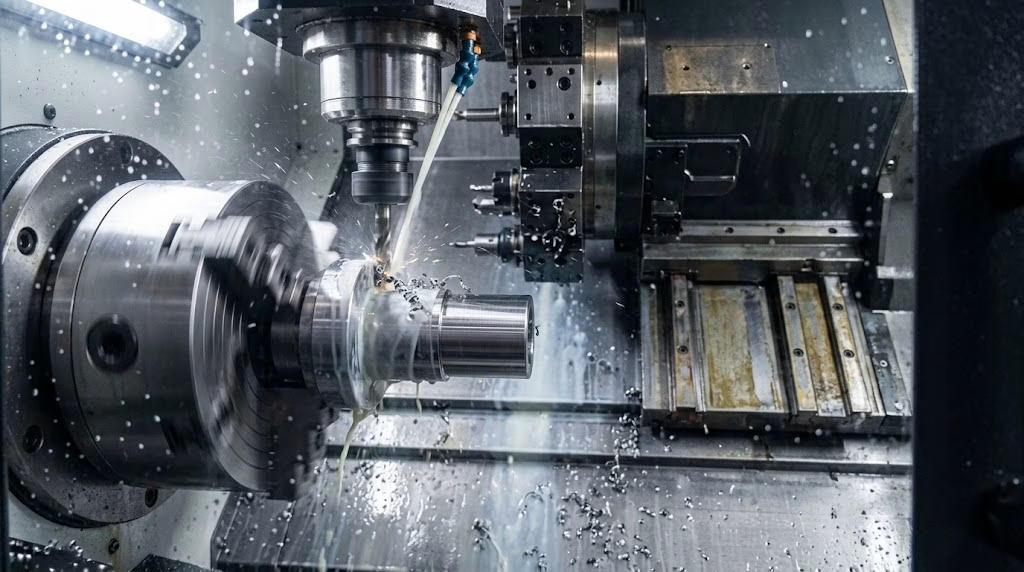
Harder steel conditions may require more robust cutting tools and carefully controlled cutting parameters.
Excessive cutting forces can contribute to:
Manufacturers should select cutting tools and machining strategies according to the actual material condition.
Machining performance is not determined by hardness alone.
Material structure, cutting-edge condition, workholding rigidity, and vibration can all affect the final surface.
For precision parts, process planning should consider both rough machining and finishing operations. Critical surfaces may require separate finishing processes to achieve the specified dimensions and surface quality.
The same steel grade may behave differently depending on whether it is supplied in an annealed, normalized, quenched, or tempered condition.
Therefore, specifying only the steel grade is not always sufficient.
Engineers should also identify the required delivery condition or final hardness whenever these characteristics affect manufacturing performance.
The decision between carbon steel and alloy steel should be based on the component’s operating requirements rather than a general assumption that alloy steel is always superior.
Carbon steel may be suitable when the component has moderate mechanical requirements and does not require specialized performance under demanding operating conditions.
Typical considerations include:
For example, a general-purpose mechanical support component may not benefit from the additional material and processing costs associated with a higher-performance alloy steel.
Alloy steel becomes a stronger candidate when the component must withstand demanding mechanical conditions.
Consider alloy steel when the design requires:
However, selecting an alloy steel should also involve evaluating machining difficulty, heat-treatment distortion, and final inspection requirements.
Consider two CNC-machined shafts.
The first shaft supports a relatively light mechanical assembly. Its design does not require particularly high strength or specialized wear resistance.
The second shaft operates under repeated mechanical loading and requires a hardened surface.
Using the same material for both components may create unnecessary costs or insufficient performance.
The correct approach is to match the material condition and manufacturing sequence to each shaft’s actual operating requirements.
Heat treatment can significantly change the mechanical properties of steel. However, it can also introduce dimensional changes that affect precision machining.
For components with tight tolerances, heat treatment should be considered during the initial manufacturing plan rather than added as a final production step.
Depending on the steel grade and treatment process, heat treatment may:
The extent of these effects depends on material composition, geometry, initial condition, and treatment parameters.
A typical manufacturing strategy for precision steel components may involve:
This sequence is not universal. Some components require different processing arrangements depending on the final hardness, geometry, and tolerance requirements.
Surface treatments can also influence final dimensions.
For example, hard chrome plating introduces an additional coating layer. Engineers must consider coating thickness, dimensional allowances, and the final required dimensions when planning the manufacturing process.
For precision components, machining, heat treatment, and surface finishing should be coordinated to avoid dimensional deviations.
The cheapest raw material does not necessarily produce the lowest-cost finished component.
Total manufacturing cost depends on material price, cutting efficiency, tool consumption, secondary operations, inspection, and production volume.
A practical cost evaluation should include:
| Cost Factor | What to Evaluate |
|---|---|
| Raw material | Purchase price and material availability |
| Machining time | Cutting efficiency and setup complexity |
| Tool consumption | Tool wear and replacement frequency |
| Heat treatment | Required processing and dimensional correction |
| Surface finishing | Coating, grinding, or polishing requirements |
| Inspeção | Measurement equipment and inspection time |
| Rework risk | Potential scrap and dimensional correction |
Choosing an excessively high-strength or high-hardness material may increase machining difficulty without providing meaningful benefits.
Engineers should avoid specifying performance characteristics that the component does not actually need.
For example, a component with moderate operating loads may not require the same material specification as a heavily loaded transmission component.
Production volume can influence the most economical manufacturing strategy.
For small batches, material availability and setup requirements may have a significant impact on unit cost.
For high-volume production, machining efficiency, tooling life, and process repeatability become increasingly important.
The objective is to optimize the total manufacturing process rather than minimize the raw material purchase price alone.
Choosing the right steel grade for CNC machining requires more than comparing strength, hardness, or material price. Engineers must evaluate operating loads, machinability, dimensional stability, heat-treatment requirements, and the complete manufacturing process.
A structured steel grade selection approach helps prevent unnecessary material costs, reduce machining risks, and improve the reliability of finished components.
The best material is not necessarily the strongest or most expensive option. It is the one that consistently meets the component’s engineering requirements while remaining practical to manufacture.
A: The most important factor is the component’s actual operating requirements. Mechanical loads, dimensional tolerances, hardness, wear conditions, and manufacturing processes should all be considered together.
A: Not necessarily, but harder material conditions can increase cutting forces, tool wear, and processing difficulty. Actual machining costs depend on the steel grade, heat-treatment condition, tooling, and component geometry.
A: When hardness affects component performance or machining requirements, it should be clearly specified together with the relevant testing method and applicable material condition.
A: Yes. Heat treatment can introduce residual stresses and dimensional distortion. Critical dimensions may require additional finish machining or grinding after treatment.
A: An RFQ should include the material grade, applicable standard, 2D drawing, 3D model, dimensional tolerances, heat-treatment requirements, surface finishing details, quantity, and inspection criteria.

Fiona Huang é engenheira de vendas com mais de 16 anos de experiência no setor da indústria mecânica e de fabrico de precisão. É especialista em componentes de maquinagem CNC, fixadores personalizados e soluções de fabrico orientadas para a engenharia. Com uma sólida experiência em comércio internacional e apoio a projetos técnicos, dedica-se a transformar requisitos de engenharia complexos em soluções de alta precisão e prontas para produção, destinadas a clientes globais.


