CNC machining steel grades play a critical role in determining the strength, durability, machinability, and cost of custom parts. Choosing the right steel grade helps manufacturers meet dimensional requirements, control production costs, and achieve reliable performance in demanding applications. Whether a component requires high wear resistance, excellent toughness, or corrosion protection, understanding the differences between steel grades is the first step toward a successful CNC machining project.
Steel is widely used in custom CNC machining because it offers a versatile combination of mechanical strength, machinability, and cost-effectiveness. However, not all steel grades behave the same during machining or in service.
An unsuitable material can cause excessive tool wear, dimensional instability, additional finishing operations, or premature component failure.
Before selecting a grade, engineers should evaluate five factors:
The best steel is not necessarily the hardest or strongest. It is the grade that meets the component’s actual performance requirements with a practical manufacturing process.
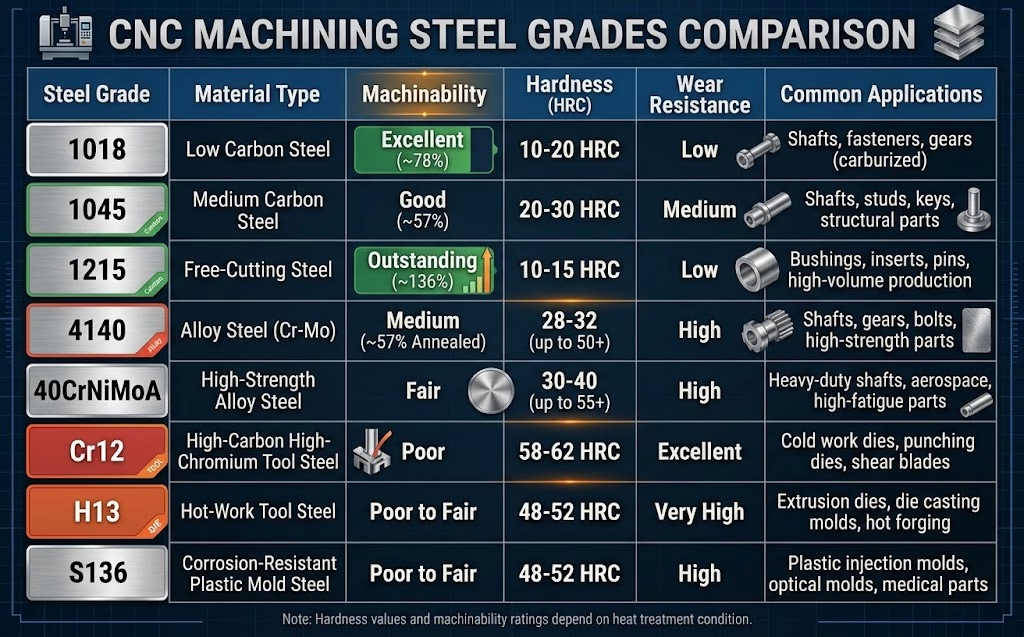
Choosing the right CNC machining steel grades depends on the required strength, machinability, wear resistance, hardness, and final application. The following steel grades are commonly considered for custom CNC machined parts, industrial components, and precision tooling.
| Steel Grade | Main Characteristics | Typical Applications |
|---|---|---|
| 1018 Carbon Steel | Good machinability, low carbon content, and suitable for general-purpose components | Pins, brackets, shafts, and mechanical parts |
| 1045 Carbon Steel | Medium carbon steel with good strength and wear resistance potential after appropriate heat treatment | Shafts, gears, and machine components |
| 1215 Free-Machining Steel | Excellent machinability and efficient chip breaking; generally unsuitable for demanding welding or high-impact applications without careful evaluation | Automatic lathe parts, fittings, screws, and precision turned components |
| 4140 Alloy Steel | Good strength, toughness, and heat-treatment response | Industrial shafts, gears, and heavy-duty components |
| 40CrNiMoA Alloy Steel | High-strength alloy steel with good toughness when properly heat-treated | High-load shafts, precision mechanical parts, and demanding industrial components |
| Cr12 Tool Steel | High carbon and chromium content with high wear resistance after suitable heat treatment | Blanking dies, punching tools, and wear-resistant tooling |
| H13 Hot-Work Tool Steel | Good hot hardness, thermal fatigue resistance, and toughness | Die-casting dies, hot extrusion tooling, and hot-working molds |
| S136 Mold Steel | Stainless mold steel offering corrosion resistance and polishability when properly processed | Plastic injection molds, precision mold inserts, and optical-quality mold components |
For general machining and cost efficiency: 1018 is suitable for many basic components, while 1215 is a strong candidate for high-volume precision turning where its mechanical limitations are acceptable.
For stronger mechanical components: 1045, 4140, and 40CrNiMoA may be considered depending on load, toughness, hardness, and heat-treatment requirements.
For tooling and mold manufacturing: Cr12 is suited to wear-resistant cold-work tooling, H13 is designed for hot-work applications, and S136 is often selected for corrosion-resistant plastic molds requiring a high-quality surface finish.
Actual performance depends on the applicable material standard, material condition, heat treatment, and manufacturing process. Before machining, confirm the exact grade and specification with the material supplier.
Actual properties depend on material condition, heat treatment, product form, and applicable specifications. Confirm the required material standard before production.
Carbon steel grades such as 1018 and 1045 are suitable for many structural and mechanical parts.
1018 is often selected for components that prioritize machinability and economical production. Grade 1045 is a common option when higher strength or surface-hardening potential is required.
Carbon steel may need protective coatings or other surface treatments when corrosion resistance is important.
Alloy steels such as 4140 and 40CrNiMoA are useful for components exposed to substantial loads, impact, or demanding mechanical conditions.
Their alloying elements and heat-treatment response can provide a useful balance of strength and toughness. However, higher hardness can increase cutting forces and tool wear.
For complex parts with tight tolerances, manufacturers should coordinate the machining sequence with heat treatment and final inspection.
Define the loads, operating temperature, wear conditions, and expected service life. A lightly loaded bracket and a high-load transmission shaft should not automatically use the same material.
Higher strength does not always mean better performance. Harder materials may require slower cutting speeds, more robust tooling, and additional machining time.
For production efficiency, choose the lowest-cost grade that reliably satisfies the component’s engineering requirements.
Heat treatment can improve hardness, strength, or wear resistance, but it may also introduce distortion or residual stress.
Surface treatments such as hard chrome plating may increase surface hardness and wear resistance. For precision components, account for coating thickness, dimensional changes, and the final required tolerance before machining begins.
Thin walls, eccentric features, deep holes, and narrow dimensional tolerances can make machining more demanding.
A capable manufacturing process may combine turning, milling, drilling, and finish machining to maintain dimensional accuracy. Critical dimensions should be clearly identified on the drawing, together with their tolerances and inspection requirements.
precision CNC machining services
Steel selection is only one part of successful CNC manufacturing. Process planning also affects quality and cost.
| Common Challenge | Recommended Approach |
|---|---|
| Excessive tool wear | Match cutting tools and parameters to the steel grade and hardness |
| Heat buildup | Optimize cutting conditions and coolant application |
| Distortion after heat treatment | Plan machining allowances and finish critical features after treatment when appropriate |
| Tight dimensional tolerances | Use controlled setups, suitable inspection equipment, and process verification |
| Corrosion during service | Select an appropriate grade and compatible protective finish |
For difficult alloy steels, early communication between the design and manufacturing teams helps identify risks before production starts.

The purchase price per kilogram is only one factor in determining the total cost of a CNC-machined component.
Material selection affects manufacturing cost through several factors, including machinability, mechanical properties, dimensional stability, and compatibility with required heat treatments or surface finishes. Different materials may require different cutting parameters, tooling strategies, or processing methods depending on the component’s geometry and technical requirements.
When comparing quotations, consider:
Providing complete drawings, material specifications, tolerance requirements, and surface-finish details allows manufacturers to make more accurate recommendations.
Selecting the right material becomes easier when engineering requirements and manufacturing capabilities are considered together.
A qualified machining partner can help assess material options, machining complexity, finishing requirements, and production feasibility before manufacturing begins.
If you are planning a custom-machined component, explore our steel cnc machining options and discuss your project requirements with our team.
Choosing the right CNC machining steel grades requires balancing strength, machinability, corrosion resistance, dimensional accuracy, and total production cost. Carbon steel is often suitable for general components, alloy steel supports demanding mechanical applications, and stainless steel is useful where corrosion resistance is essential.
The most effective choice starts with the component’s operating conditions and ends with a manufacturing process that consistently meets its engineering requirements. By evaluating material properties and machining constraints early, businesses can improve part reliability, production efficiency, and long-term value.
A: Common choices include 1018 and 1045 carbon steel, 4140 and 40CrNiMoA alloy steel. The appropriate grade depends on strength, machinability, corrosion resistance, and application requirements.
A: Low-carbon steels such as 1018 are generally easier to machine than many hardened alloy steels. Actual performance depends on material condition, tooling, and cutting parameters.
A: Yes. 4140 is widely used for precision mechanical components requiring a balance of strength and toughness. Its hardness and heat-treatment condition should be considered when planning machining operations.
A: It depends on the component, required hardness, geometry, and tolerance. Rough machining before heat treatment followed by finish machining is one common approach, but the sequence should be determined by distortion risk and final specifications.
A: Select a steel grade that meets actual performance requirements, simplify unnecessary geometric complexity, specify realistic tolerances, and plan heat treatment and finishing early. Complete technical drawings also help reduce quotation uncertainty and avoid rework.

Fiona Huang is a Sales Engineer with 16+ years of experience in the mechanical and precision manufacturing industry. She specializes in CNC machining components, custom fasteners, and engineering-driven manufacturing solutions. With strong expertise in international trade and technical project support, she focuses on transforming complex engineering requirements into high-precision, production-ready solutions for global clients.


