Copper CNC turning vs milling is an important manufacturing decision that affects part accuracy, surface finish, production efficiency, and cost. Turning is generally better for cylindrical components, while milling is more suitable for parts with flat surfaces, slots, pockets, and complex profiles. Choosing the right process depends on the component’s geometry, copper grade, tolerance requirements, and production volume.
Understanding these differences helps engineers select an efficient machining strategy for copper electrical contacts, connectors, heat-transfer components, and precision mechanical parts.
Copper CNC turning uses a rotating copper workpiece and a cutting tool to remove material. It is particularly effective for producing round components with concentric or symmetrical features.
Typical applications include:
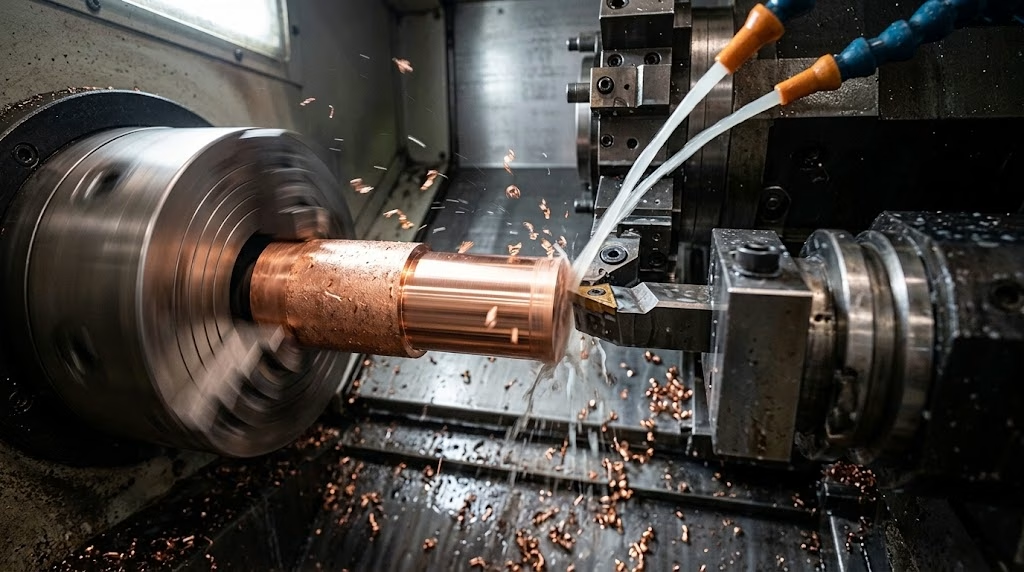
Turning can efficiently produce rotational features, maintain consistent diameters, and reduce unnecessary tool movements when machining suitable geometries. It is often a practical choice for repetitive production of round copper parts.
However, turning alone is less suitable for features such as rectangular pockets, cross-holes, complex flat profiles, and irregular contours. These features may require secondary milling or drilling operations.
Copper CNC milling uses rotating cutting tools to remove material from a stationary or securely positioned workpiece. The process supports a wider range of geometries than conventional turning.
Copper milling is frequently used for:
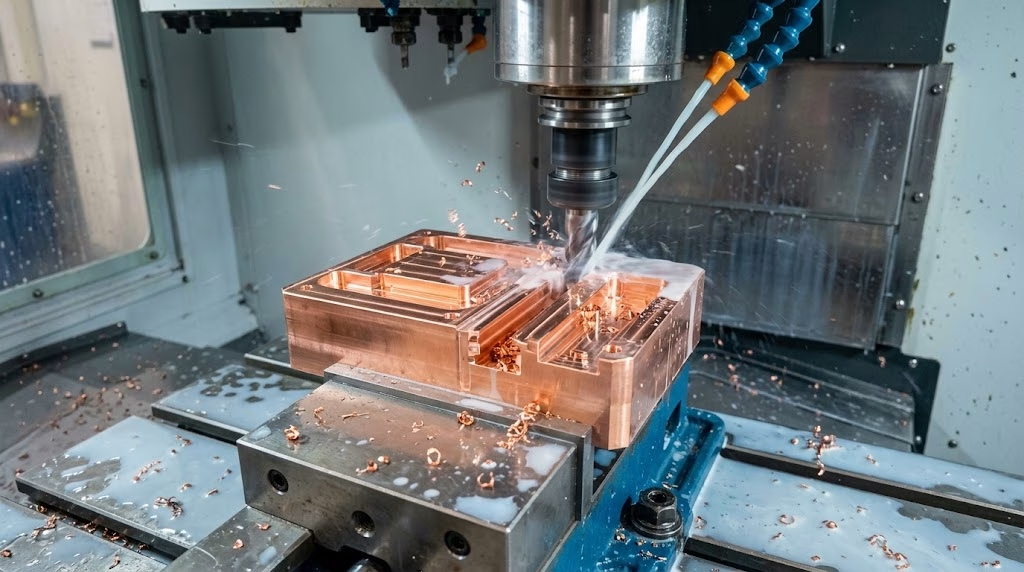
Milling offers flexibility for complex geometries and multiple feature types. It can machine flat surfaces, grooves, pockets, and angled features within one setup when the machine configuration permits.
Its limitations include potentially longer machining times for large material-removal tasks and challenges controlling burrs, tool wear, and surface finish. These issues become more significant when machining soft, ductile copper grades.
The best process depends on which features dominate the part design.
| Comparison Factor | Copper CNC Turning | Copper CNC Milling |
|---|---|---|
| Ideal geometry | Cylindrical and rotational | Flat, prismatic, and complex |
| Typical features | Diameters, grooves, threads, shoulders | Slots, pockets, holes, contours |
| Material removal | Efficient for rotational profiles | Flexible for localized and multi-sided removal |
| Setup considerations | Workpiece gripping and concentricity | Workholding and tool accessibility |
| Surface finish | Suitable for turned cylindrical surfaces | Suitable for flat and contoured surfaces |
| Production suitability | Efficient for repetitive round parts | Flexible for varied part geometries |
| Common challenges | Chatter, dimensional variation, workpiece deflection | Burrs, chip evacuation, tool deflection |
Neither process is universally superior. The most economical solution is the one that matches the geometry and required features without adding unnecessary operations.
Start with the engineering drawing. If the part mainly consists of concentric diameters, shoulders, and circular grooves, turning is usually the logical starting point.
For components with rectangular profiles, multiple pockets, or irregular surfaces, milling is generally more appropriate. Parts combining both feature types may benefit from a combination of turning and milling.
Copper grades differ in conductivity, strength, and cutting behavior. Pure copper is relatively soft and ductile, which can cause material smearing, built-up material on cutting edges, and burr formation.
Selecting suitable cutting tools, sharp edges, stable fixtures, and appropriate cutting conditions is essential for both processes. Copper alloys may machine differently from pure copper, so parameters should be selected according to the actual material grade and equipment.
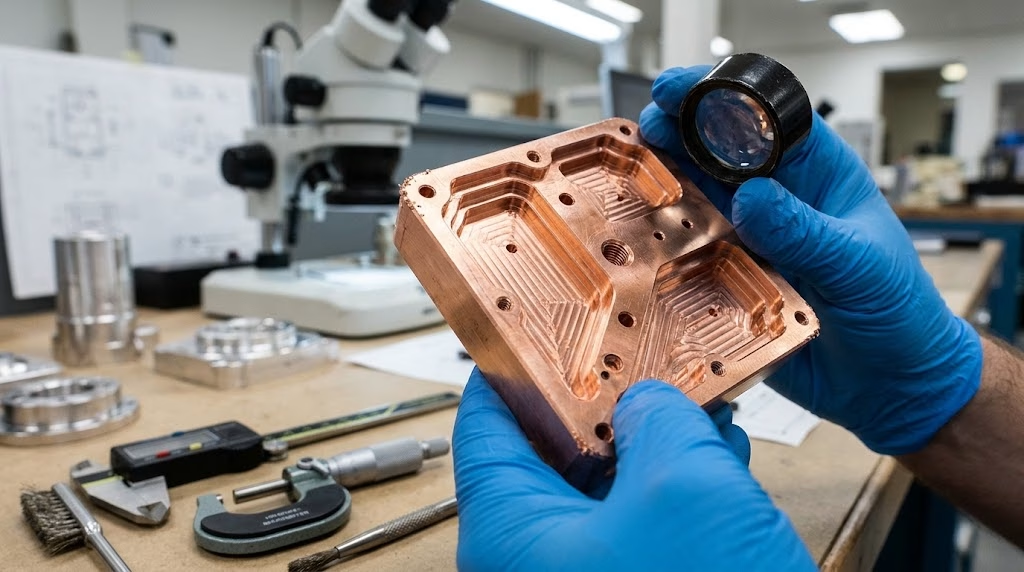
Tight dimensional tolerances require stable workholding, controlled cutting conditions, and reliable inspection methods. Turning is often advantageous for round features that require consistent diameters, while milling is better suited to flatness, pocket dimensions, and feature positions.
For demanding applications, confirm critical dimensions through appropriate measurement methods and inspect the finished part against the drawing.
The lowest-cost process is not always the one with the shortest individual machining cycle. Consider programming, setup, tooling, material waste, secondary operations, inspection, and production volume.
| Part Requirement | Recommended Starting Point |
|---|---|
| Round pin or cylindrical spacer | CNC turning |
| Flat copper contact plate | التفريز باستخدام الحاسب الآلي الرقمي |
| Copper component with pockets and slots | التفريز باستخدام الحاسب الآلي الرقمي |
| Round component with milled flats | Turning plus milling |
| Complex part with several feature types | Multi-operation or mill-turn strategy |
These recommendations are starting points. Final process selection should reflect the complete drawing and production requirements.
Copper’s ductility and thermal properties create several manufacturing considerations.
When a component requires both turned diameters and milled features, careful operation sequencing can reduce repeated setups and help preserve dimensional relationships.
Some copper components cannot be manufactured efficiently through turning or milling alone. A combined approach is worth considering when a part includes cylindrical sections together with cross-holes, flats, slots, or non-rotational features.
The main benefit is the opportunity to complete related features with fewer setups, depending on machine capabilities. This can improve alignment between features and reduce handling time.
Before selecting a combined process, review the drawing, critical tolerances, required finish, and expected quantity with your machining supplier.
For application-specific process planning and manufacturing support, explore Yumei’s copper cnc machining capabilities.
Copper CNC turning vs milling comes down to part geometry, material grade, dimensional requirements, and overall manufacturing efficiency. Turning is generally the preferred choice for cylindrical copper components, while milling offers greater flexibility for flat surfaces and complex features. When a design combines both, an integrated machining strategy may deliver better efficiency and dimensional consistency.
The most effective approach is to evaluate the complete part drawing before committing to a process. Proper tool selection, chip control, workholding, and quality inspection are essential to producing reliable copper components.
A:Turning is generally better for cylindrical parts, while milling is better for flat, slotted, pocketed, and complex geometries. The design determines the most suitable process.
A:Yes. Components with cylindrical sections and additional milled features can use both processes, either through separate operations or suitable mill-turn equipment.
A:Copper is ductile and can deform rather than shear cleanly. Tool sharpness, cutting geometry, feed conditions, and material grade all influence burr formation.
A: The choice depends on the application’s conductivity, strength, corrosion resistance, and machinability requirements. Pure copper and copper alloys should be evaluated separately.
A:Use suitable sharp cutting tools, stable workholding, material-specific cutting conditions, effective chip evacuation, and appropriate finishing and inspection procedures.

فيونا هوانغ هي مهندسة مبيعات تتمتع بخبرة تزيد عن 16 عامًا في قطاع التصنيع الميكانيكي والتصنيع الدقيق. وهي متخصصة في مكونات التصنيع باستخدام الحاسب الآلي (CNC)، ومثبتات التثبيت المصممة حسب الطلب، وحلول التصنيع القائمة على الهندسة. وبفضل خبرتها الواسعة في التجارة الدولية ودعم المشاريع التقنية، تركز فيونا على تحويل المتطلبات الهندسية المعقدة إلى حلول عالية الدقة وجاهزة للإنتاج للعملاء حول العالم.


