Custom copper CNC machined parts help electrical manufacturers produce connectors and terminals with accurate dimensions, reliable conductivity, and application-specific geometries. From compact electrical contacts to complex conductive terminals, CNC machining supports the production of copper components designed for demanding electrical assemblies.
However, manufacturing these parts requires more than selecting a conductive material. Copper’s softness, ductility, and tendency to form burrs can affect dimensional accuracy, surface quality, and assembly performance. Choosing the right copper grade, machining strategy, and inspection methods helps manufacturers achieve consistent results.
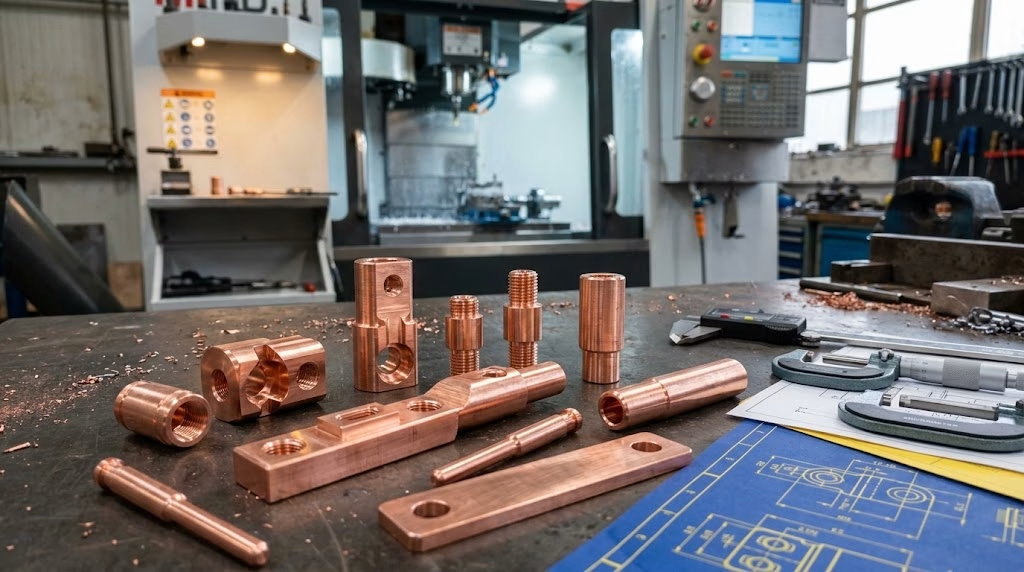
Copper is widely used in electrical applications because it combines excellent electrical conductivity with good thermal conductivity and formability. It is suitable for components that transfer current between wires, circuit elements, busbars, and electrical equipment.
The final performance depends on copper grade, component geometry, operating conditions, contact pressure, surface finish, and any applied coating.
Custom copper components serve a range of electrical connection requirements. CNC machining is especially useful when a part requires precise features that are difficult to achieve consistently with simpler manufacturing methods.
| Component Type | Typical Features | Main Design Consideration |
|---|---|---|
| Electrical connectors | Contact surfaces, bores, threads | Contact resistance and dimensional fit |
| Copper terminals | Mounting holes, clamping areas | Connection stability and current capacity |
| Conductive contact pins | Small diameters and defined contact zones | Surface quality and dimensional consistency |
| Busbar connectors | Slots, holes, and complex profiles | Current distribution and assembly alignment |
| Custom conductive blocks | Multiple machined faces and threaded holes | Geometry, heat transfer, and installation |
A copper connector must fit correctly within its assembly while maintaining suitable electrical contact. Hole diameter, thread quality, flatness, and contact-surface condition can all influence installation and performance.
Engineers should define the critical dimensions and functional surfaces before production. This allows machining operations and inspection procedures to focus on the features that matter most.
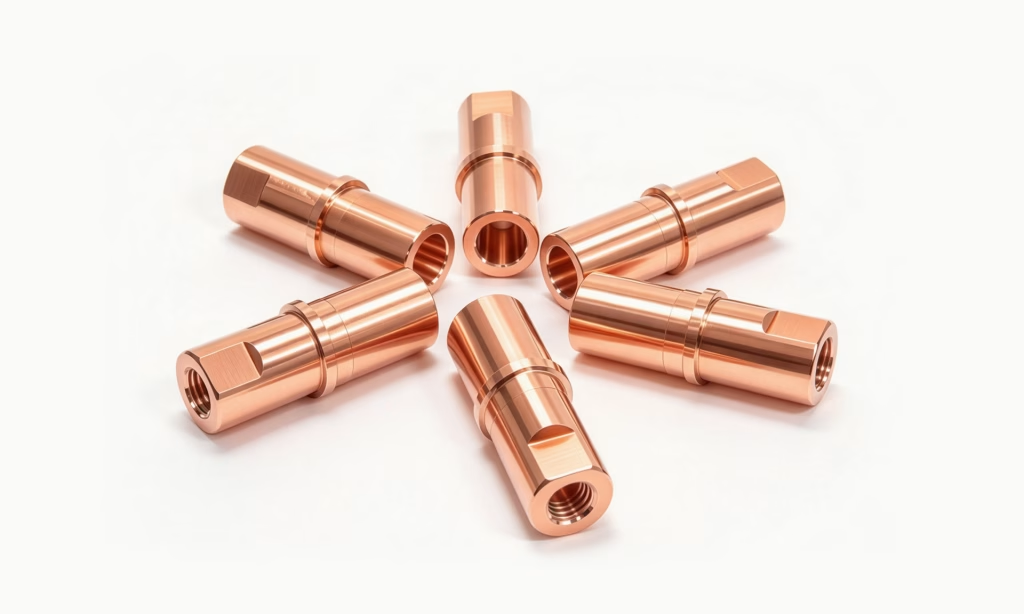


Copper CNC machining uses programmed cutting operations to manufacture parts according to engineering drawings or three-dimensional models. Depending on the design, manufacturers may use CNC milling, CNC turning, drilling, tapping, or a combination of processes.
CNC milling is suitable for copper components with slots, flat surfaces, pockets, mounting features, and irregular profiles. It offers flexibility for custom designs and prototype development.


Tool geometry, cutting conditions, workholding, and chip evacuation should be selected according to the copper grade and component structure. Sharp cutting edges and effective chip removal can help reduce burr formation and surface defects.
CNC turning is appropriate for round terminals, threaded connectors, contact pins, and other rotationally symmetric parts. It supports controlled diameters, concentric features, and repeatable production.

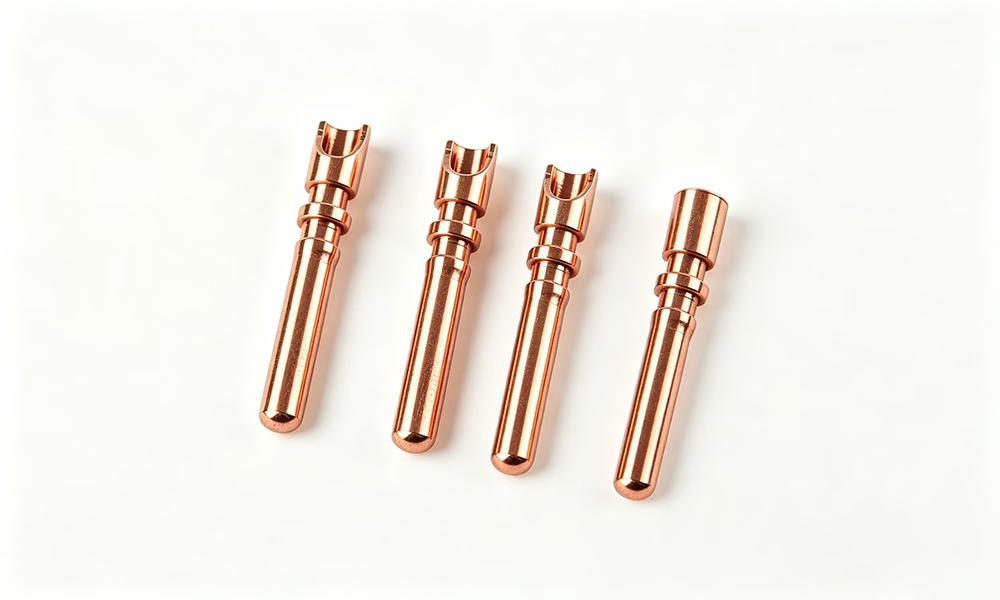

For components with both turned and milled features, combined machining operations may reduce repositioning and help maintain the relationship between critical dimensions.
Copper’s ductility can cause material to deform rather than separate cleanly during cutting. Burrs may form around drilled holes, slots, and machined edges, potentially affecting assembly or electrical contact.
Manufacturers can address these issues through appropriate tool selection, stable workholding, optimized cutting conditions, controlled deburring, and inspection of functional edges.
Material selection affects conductivity, strength, machinability, and suitability for the intended environment.
| Material de cobre | General Characteristics | Potential Applications |
|---|---|---|
| C11000 / electrolytic tough-pitch copper | High electrical conductivity | Conductive connectors and terminals where suitable |
| C10100 / oxygen-free electronic copper | Very high purity and conductivity | Specialized conductive components |
| C14500 / tellurium copper | Improved machinability compared with many high-conductivity copper grades | Precision electrical contacts and machined conductive parts |
The suitability of each grade depends on the required conductivity, mechanical properties, operating environment, and applicable material specifications. Material certificates and incoming inspection can help verify that the selected grade meets project requirements.
Related Reading: Selection of Copper Materials
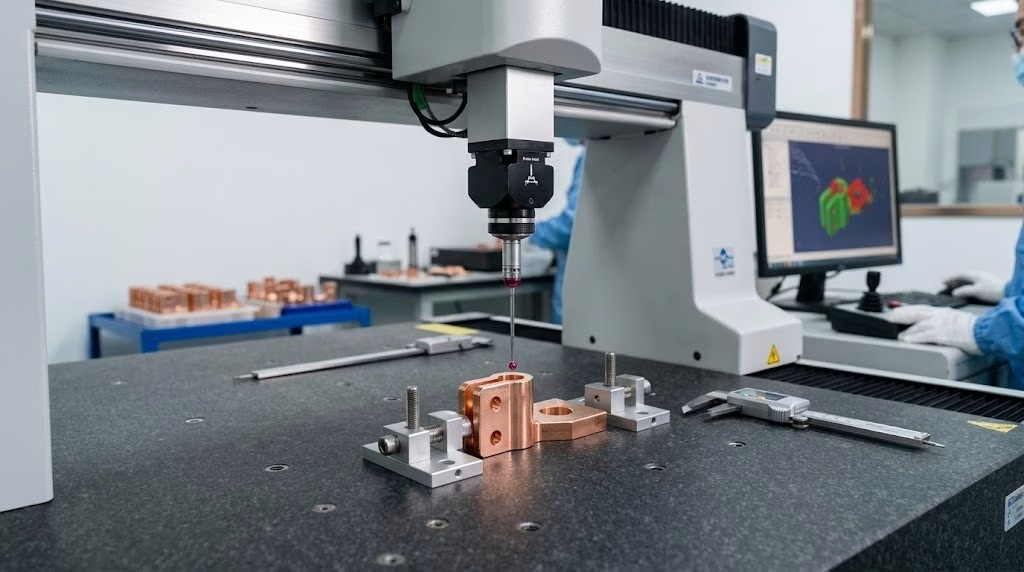
Quality control is essential because small dimensional variations may affect how a connector fits, clamps, or contacts another conductive component.
Coordinate measuring machines, micrometers, gauges, and other measurement tools may be selected according to feature geometry and tolerance requirements. Electrical testing can also be incorporated when the application requires verification of conductivity or contact performance.
A clear request for quotation helps manufacturers evaluate production feasibility and provide a more accurate quotation.
Include the following information:
For complex parts, a design-for-manufacturing review can identify difficult features, unnecessary tight tolerances, and opportunities to simplify machining without compromising function.
Selecting a manufacturing partner with experience in precision copper machining can help streamline prototype development, improve dimensional consistency, and reduce production risks.
Yumei provides machining solutions for custom metal components. When evaluating a supplier, consider its ability to review drawings, select suitable materials, manage burrs, inspect critical dimensions, and maintain documented quality controls.
Explore our Copper CNC Machining services to learn more about manufacturing copper components for your application.
Custom copper CNC machined parts support the production of electrical connectors, terminals, contact pins, and other conductive components requiring precise geometry and dependable material performance. Successful manufacturing depends on selecting the appropriate copper grade, choosing suitable machining operations, controlling burrs, and verifying critical dimensions.
By providing clear engineering requirements and working with an experienced machining partner, electrical manufacturers can improve part consistency, simplify assembly, and develop copper components tailored to their specific applications.
A: They are used for electrical connectors, terminals, conductive pins, busbar connections, and other components that require controlled dimensions and electrical conductivity.
A: The best grade depends on conductivity, mechanical strength, machinability, and operating conditions. C11000 is a common option for high-conductivity applications, while other grades may be appropriate for specialized requirements.
A: Yes. CNC milling and turning can produce holes, threads, slots, contact surfaces, and complex profiles. The achievable geometry depends on the equipment, tooling, workholding, and part design.
A: Suitable sharp tooling, optimized cutting conditions, effective chip evacuation, stable workholding, and controlled deburring can help reduce burr formation. Inspection should focus on edges that affect assembly or electrical contact.
A: Yes. Copper components can be compatible with suitable finishes, including tin, nickel, or silver plating, depending on the application. The required coating should be specified according to conductivity, contact performance, corrosion resistance, and operating conditions.

Fiona Huang é engenheira de vendas com mais de 16 anos de experiência no setor da indústria mecânica e de fabrico de precisão. É especialista em componentes de maquinagem CNC, fixadores personalizados e soluções de fabrico orientadas para a engenharia. Com uma sólida experiência em comércio internacional e apoio a projetos técnicos, dedica-se a transformar requisitos de engenharia complexos em soluções de alta precisão e prontas para produção, destinadas a clientes globais.


